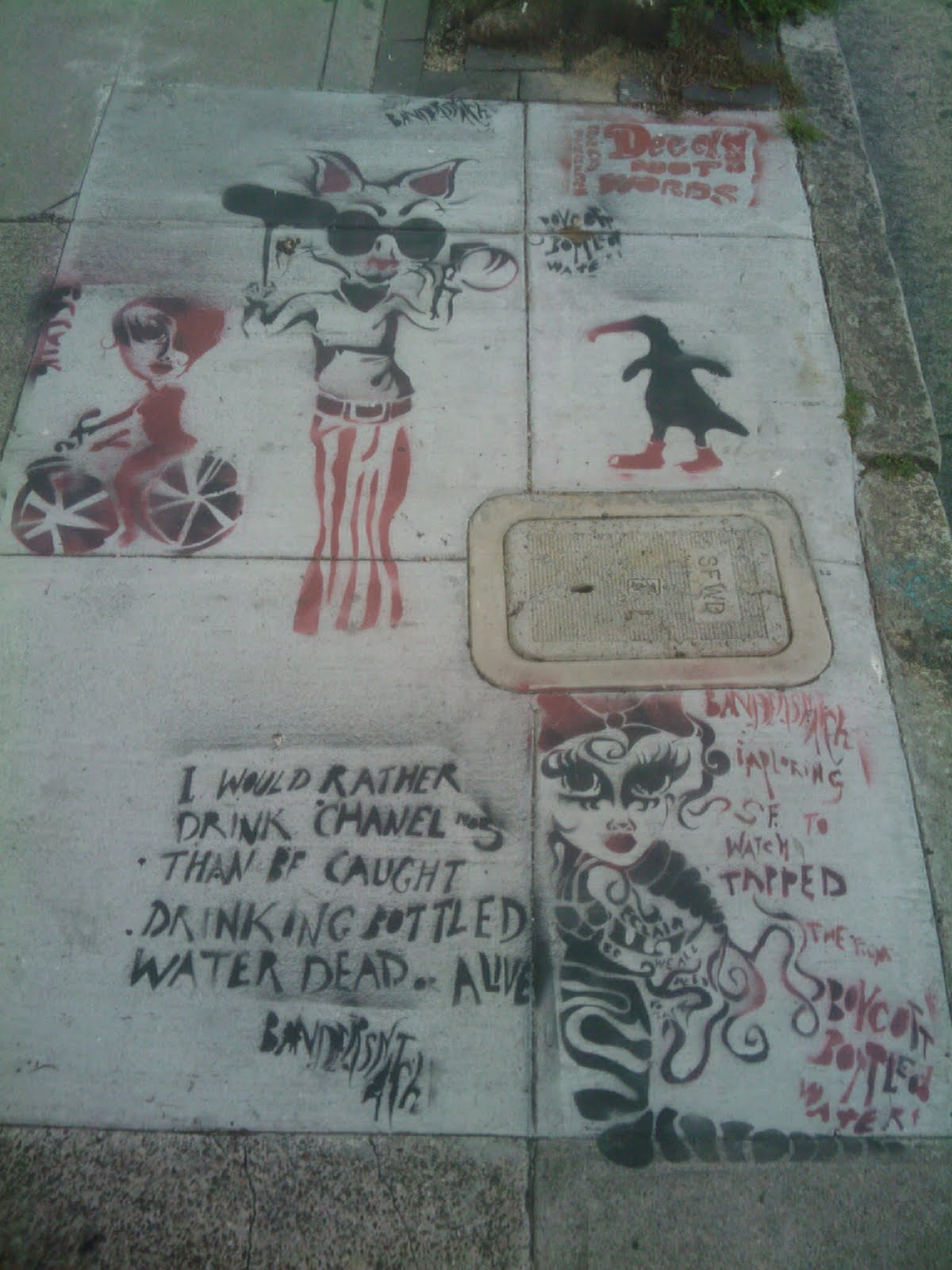
Boycott Bottled Water Graffito in SF

One great thing about San Francisco is that you get used to finding things on the street. This morning, for example, on the way to a friend’s house I came across a box of books, and took a couple for myself, including A Wild Sheep Chase by Haruki Murakami.

You also find graffiti, much of it lame, some of it great. This piece is a black and red (heh) stencil, around a San Francisco Water Department access panel, poetically enough:

Continue reading “Boycott Bottled Water Graffito in SF”

Book Review: The Anti-Capitalism Reader

book cover

I picked up this collection of essays many years ago. I had read a few of the pieces here and there, but recently decided to read the whole thing through from front to back. I got a startling sense of time warp.

I write this just two weeks after Osama bin Laden was assassinated by the United States, an event that seems anti-climactic, of an unimportance that would be astonishing to any time-traveler from nine or ten years ago. Already the story is fading from the news, subject only to occasional reverberations around discussion of the merits of torture or conspiracy theories that he is still alive. There is no indication that the US is any closer to ending its occupations of Iraq or Afghanistan, its wars in Libya or Pakistan, or its various military actions in other places across the world.

The Anti-Capitalism Reader, edited by Joel Schalit, was published in 2002, and many of the essays refer to the events of September 11th, 2001. Reading the interviews and analysis, you can feel the epochal status of 9/11 at that time, while now it has faded, representing only the turning point to the Dreary New Normal. Continue reading “Book Review: The Anti-Capitalism Reader”

On Republican Donor Support for Same-sex Marriage

I recently read this New York Times article on GOP donor support for same-sex marriage. Astonishingly, most of the new money to lobby for same-sex marriage in New York state is coming from wealthy donors to the Republican party.

Predictably, it’s seen from two angles: 1) libertarian – it’s not the state’s business to butt into people’s relationships – and 2) support for same-sex marriage is “good for business” and would be part of New York state’s “competitive advantage”.
Continue reading “On Republican Donor Support for Same-sex Marriage”

Class and Unhappiness

I had a bizarre evening. I went to a party at the house of a colleague who, it turns out, is quite rich. I couldn’t help but see class in all the interactions of the evening, especially the hired staff in the background who cleared away plates and poured drinks. I had a great conversation with the doorman, who plays poker online for a living, and was doing this job to make ends meet while waiting to collect money held up in various online forums due to the US trying to illegalize online gambling.

Later, on the way home, I ran into a friend of a friend who is a solid middle-class blue-collar worker, doing carpentry in the homes of the rich. He pointed out that the rich are often miserable. We talked for a while about how the system is so fucked up that even those who are “benefiting” from it, those who succeed by its rules, are often unhappy. In other words, even many elements of the ruling class are so unhappy under our current social system that they are amenable to a discussion about how we could organize our lives differently.

We don’t envy the rich so much as we feel sorry for them. And we extend our hand to them, to join us in creating an entirely new world.

Update – 2011/05/16

I don’t mean to imply that all rich people (or the party host) are unhappy. But I do think there is a pattern where unhappy people who aren’t well-off can imagine that their unhappiness will be cured by money; if they succeed in becoming rich, and remain unhappy, they are at a loss for what the underlying problem could be. Even the “winners” in our society are often profoundly alienated.

Transcription/Translation of Félix Guattari – Université de Vincennes 1975 (In-progress)

This video is the top Google video result for “Guattari“. The top two comments for this video say “what Guattari is describing in this lecture is Facebook. It’s beyond unnerving. In 1975.” and “Guattari avait en 1975 deja prevu Meetic et tout le delire d aujourd hui de rechercher l ame soeur sur Internet” (Guattari had in 1975 already foreseen Meetic [a dating site like Match.com] and all of today’s delirium about finding a soulmate on the internet). This sounds very interesting, but it’s in French with Italian subtitles that are in places obscured by the TV station logo.

I transcribed the Italian subtitles as best I could, doing some spell-checking and spot-checking with Google Translate. I hope to transcribe the French, which will take a lot more time, and from there attempt an English translation.

Continue reading “Transcription/Translation of Félix Guattari – Université de Vincennes 1975 (In-progress)”

Book Review: The Invention of Air

I was so impressed by Steven Berlin Johnson’s book Where Good Ideas Come From that I immediately bought two more of his books. I have just finished reading The Invention of Air: A Story of Science, Faith, Revolution, and the Birth of America, about Joseph Priestley, a remarkable but overlooked historical figure.

Johnson describes Priestley as “a lost Founding Father” of the United States – a friend of Ben Franklin, a major contributor to Thomas Jefferson’s religious outlook, and a key figure in the controversy over the infamous Alien and Sedition Acts of 1798. He is most well known as one of the discoverers/inventors of oxygen, but Johnson spins his key discovery – that plants generate oxygen and make “bad” air good – as the start of ecosystem science. He was a famous scientist (or “natural philosopher”) in his time, but also famous for his religious and political radicalism. The closest we might have to someone of his stature in our day is Noam Chomsky, who is a giant in the scientific field of linguistics and also a prolific writer on politics from a radical viewpoint.

Continue reading “Book Review: The Invention of Air”

Book Review: A Hacker Manifesto (In-Progress)

“Information wants to be free but is everywhere in chains.”

In an interview, Slavoj Zizek points out (page 80 of The Anti-Capitalism Reader):

[A]t the most elementary level, Marx’s concept of exploitation presupposes a certain labor theory of value. If you take this away from Marx, the whole edifice of his model disintegrates. What do we do with this today, given the importance of intellectual labor? Both standard solutions are too easy – to claim that there is still real physical production going on in the Third World, or that today’s programmers are a new proletariat.

In A Hacker Manifesto, McKenzie Wark attempts to tackle this problem, re-interpreting and adapting Marx to our current age. He does it with insight, wit, and poetic flair, but he is not always easy to follow, particularly if you are not already familiar with some Marxian jargon. This book review is also an attempt to help you interpret and understand what the book is trying to say.

It is still unfinished; I am editing it online. It will be marked as “in-progress” until I am done. In fact, right now it is just a series of notes. I have just finished reading the book, but need to think about it, rehash, perhaps re-read, and start all over again.


Glossary

Need to start a glossary. abstraction, adequacy (special meaning in philosophy), alienation, appropriation, bifurcation, capitalist, class, commodification, commodity, communication, contingent, envelope, expression, flow, hack, hacker class, hacking, history, information, interiority, nature, necessity, object, pastoralist, productive classes, production, recuperation (special meaning in philosophy/Marxism), representation, second nature, spectacle, stock, subject, subjectivity, surplus, telesthesia, third nature, vector, vectoralist, virtuality


A friend lended me A Hacker Manifesto by McKenzie Wark. Already upon opening the book, I noticed something strange. I went to see how many pages it had by turning to the back and looking for page numbers. There are none. But I can tell you it is 389 paragraphs long.

I started turning pages from the front of the book, and saw this:

ABSTRACTION CLASS EDUCATION HACKING HISTORY INFORMATION NATURE PRODUCTION PROPERTY REPRESENTATION REVOLT STATE SUBJECT SURPLUS VECTOR WORLD WRITINGS

Continue reading “Book Review: A Hacker Manifesto (In-Progress)”